
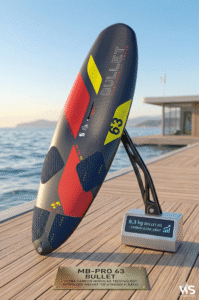
In windsurf slalom, conversations about equipment often focus on shapes, fins, sail sizes, or mast tracks. But one variable always comes up in the background: board weight.
Riders often assume lighter automatically means faster. But how much does board weight actually affect performance on the water?
Let’s start with the numbers.
The Real Weight of Modern Slalom Boards
Looking at production boards used for racing, most modern carbon slalom boards fall into a relatively narrow weight range.
Examples from different brands show a consistent pattern:
Small slalom boards (~78–97 L): about 5.3–6.5 kg
Medium boards (~99–109 L): around 5.8–7.0 kg
Larger boards (~120–135 L): about 7.0–8.0 kg
Overall, most high-performance slalom boards weigh roughly between 5 and 8 kg, depending mainly on volume and construction.
These figures are typically declared weights, used by brands as a reference in their technical specifications.
In other words, across the entire slalom category, the difference between two competing boards is often less than 1 kg.
So the real question becomes:
Is that kilogram actually important?
Where Weight Makes a Difference
There are three phases where board weight can influence performance.
1. Early Planing and Acceleration
A lighter board requires less energy to start moving.
In marginal wind conditions, this can translate into:
quicker acceleration after pumping
earlier planing
slightly faster response under the sail
From a physics standpoint, the explanation is simple: reducing mass means less inertia, so the board responds faster to power from the rig.
However, once the board is fully powered and settled on the fin, the advantage becomes much smaller.
2. High-Speed Control in Chop
This is where weight can actually become an advantage.
At slalom speeds — often well above 25 knots — the board is constantly interacting with chop and surface turbulence. A board with slightly more mass carries more momentum, which helps it maintain a smoother and more predictable trajectory through disturbed water.
In practical terms, this can translate into:
greater stability at full speed
less nervous reactions in heavy chop
more confidence when pushing hard in strong wind
Extremely light boards can feel very reactive, but they may also react more abruptly to every piece of chop. When the water gets rough and the speed increases, a board with the right amount of mass often feels more planted on the water and easier to keep under control.
3. Gybes
In gybes, lower mass can make the board:
easier to roll onto the rail
quicker to redirect
more responsive under foot pressure
But again, the difference is subtle.
At racing speeds, rail shape, rocker, and tail design usually have a far greater impact on gybing performance than a small variation in board weight.
The Hidden Trade-Off: Durability
Reducing weight almost always involves trade-offs.
To build lighter boards, manufacturers may:
reduce laminate thickness
simplify outer layers
optimize carbon structures
These approaches can remove hundreds of grams from the final weight.
But they can also make the board:
more fragile
more sensitive to impacts
less tolerant to heavy use over time
Because of this, many designs aim for a balance between performance weight, structural stiffness, and durability.
The Reality: Weight Is Not the Main Performance Factor
In slalom windsurfing, speed comes primarily from three things:
Hydrodynamic efficiency of the shape
Control at high speed
Average speed through gybes
Board weight plays a role, but it is not the dominant factor.
A well-designed board that is slightly heavier can easily outperform a lighter board with a less efficient shape — especially when the wind increases and control becomes critical.
That’s why most modern slalom designs cluster around a similar weight range. Designers aim for the best compromise between:
stiffness
durability
control
and manageable weight.
The Takeaway
Yes, board weight matters.
But probably less than many riders think.
Once a board is within the typical slalom range (roughly 6–8 kg depending on volume), the real gains come from design, balance, and control, not from chasing the absolute lowest number on the scale.
In racing, speed is rarely about a single parameter.
It’s about how all the pieces work together once the board hits the water.